

Table of Contents
How to waterproof a basement below ground and avoid negative pressure moisture problems
If your below-ground basement has moisture stains, mold, mildew, bad odors, or paint and plaster peeling, you may need to waterproof your basement. Negative pressure dampness is a common problem in underground construction and occurs when water from the surrounding ground seeps through the walls and floor.
Without proper waterproofing, this moisture can generate:
Deteriorationof walls and floors, weakening the structure.
Loss of thermal insulation, increasing the feeling of cold and heating costs.
Formation of mold and fungi, damaging the air quality.
Bad odors and an unhealthy environment.

What is the best way to waterproof a basement underground?
There are different methods for waterproofing underground or buried basements, but not all of them offer a lasting solution.
🔴 Damp-proof paints → They are only a temporary solution. They do not block moisture, but rather mask it, and end up flaking over time.
🔴 Plaster or mortar coatings → They do not prevent water seepage, so the problem reappears.
✅ G-Flex → G-Flex waterproof sheeting is the most effective and durable solution.
G-Flex is a system for waterproofing basements from the inside, designed to create a waterproof barrier that blocks moisture without the need for intervention on the outside.
✅ Benefits of waterproofing a basement with G-Flex
✔️ Durable solution → Unlike other options, G-Flex does not deteriorate over time or depend on the condition of the substrate.
✔️ Easy installation without exterior work → No need to excavate around the house, which reduces costs and labor time.
✔️ Completely insulates walls and floors from moisture → Prevents water from being transferred to the interior.
✔️ Improves air quality → Reduces mold and moisture buildup in the room.
✔️ Suitable for rehabilitation and new construction → Can be used in any type of construction.
Differences between waterproofing buried basement walls and floors
Waterproofing basement walls
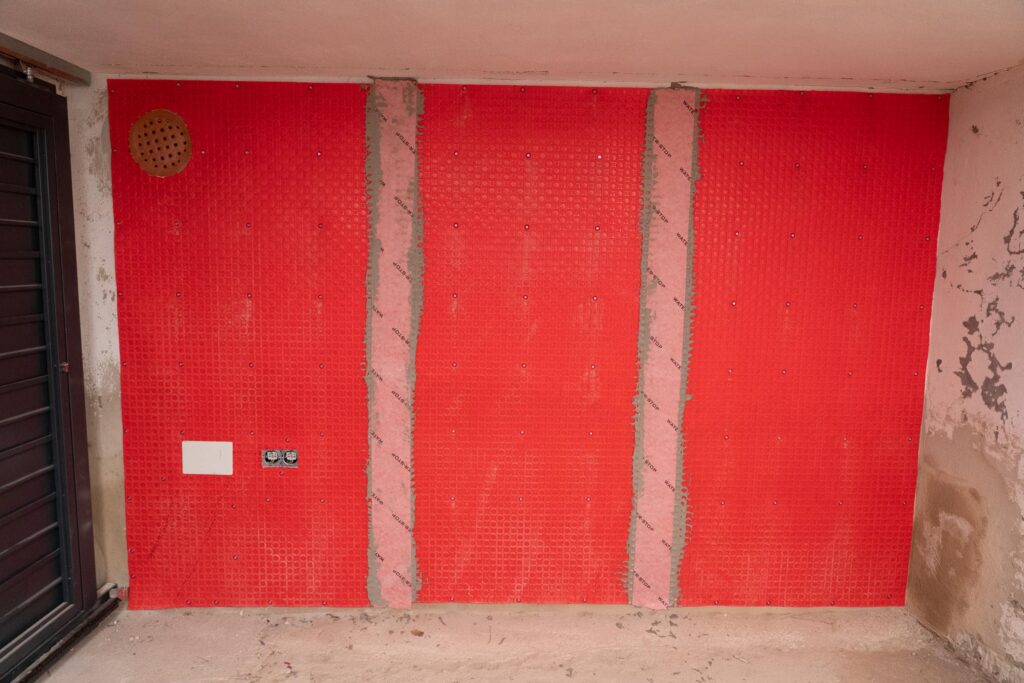
- Mechanically fastened with special screws and washers (G-Washers).
- A space is left at the top and bottom to allow air circulation and moisture dissipation.
- The joints between sheets are sealed with W-S BAND and EASEAL waterproof cement.
- It can then be covered with mortar or any type of coating: ceramic, wood, marble…
Waterproofing the basement floor
- It is placed directly on the affected floor without the need to remove the screed.
- The film allows moisture to flow through without affecting the top layer.
- If water accumulates, it is recommended to install a drainage system to channel it to a drain.
- It can be covered with tiles or other finishes, ensuring a stable and dry base.
When is a drainage system needed for basement waterproofing?
If the humidity level is high and there is water accumulation in the basement, the combination of G-Flex with a drainage system is the best solution. This allows the water to be directed to a sump or bilge pump for evacuation.