


An expansion joint is an intentional space -open or filled with a flexible material- that is incorporated in floors, floors slabs, facades or party walls to absorb movements due to:
- Temperature changes (thermal expansion)
- Humidity variations
- Differential ground settlements
- Vibrations or dynamic loads
It should be borne in mind that if they are not planned correctly, these stresses end up breaking the material, causing irregular cracks, raised tiles or water seepage that can compromise structural safety and the comfort of users.
Table of Contents
Expansion joints between buildings
When two built volumes adjoin, differences in settlement or expansion can generate concentrated stresses in the party wall. For this reason, expansion joints between buildings are resolved by leaving a 10-20 cm gap free of rigid materials, protected on the roof with sloping gutters to drain water, and on the façade with metal or PVC profiles incorporating rubber strips. This ensures that each building evolves without transmitting movements to the neighbor or allowing leaks at the meeting point.
However, not all gaskets serve the same purpose and are not placed in the same location. There are three main types:
-
Structural joints. They are the extension, in the ceramic tiling, of the joints foreseen in the supports and underlying structures (slabs, columns, beams). These joints must be respected in all their depth and width, crossing all the layers of the system – from the tile to the bonding mortar or any decoupling or insulation sheet – so that each fragment can move independently, without transmitting forces to the adjoining panel.
-
Perimeter joints. They delimit the edge of the tiling from rigid construction elements -walls, columns, closings- that do not share the same capacity for movement. Thanks to this separation, displacements of the wall do not affect the flooring or the baseboard, and vice versa. In dwellings, when the surface to be covered is less than 10 m², these joints can be eliminated for reasons of design or hygiene, provided that the tiles are 5 mm from the vertical element. In any other case, the perimeter joint must be at least 6 mm wide and reach the separating layer to fulfil its function.
-
Intermediate joints. They divide the tile covering into smaller pieces – usually rectangular or square – so that each tile fragment can react to thermal and humidity changes with less effort. In installations without radiant heating, they are usually spaced every 8-10 m linearly, with depth also down to the separating layer. In floors with underfloor heating, this subdivision is adjusted to grids of about 25 m² (or every 5 m linear) to accommodate the temperature and movement of the heating system.
Given that a tile covering is, in reality, a multilayer system (tile, adhesive, distribution mortar, decoupling or waterproofing sheets, insulation), the correct execution of these three categories of joints-structural, perimeter and intermediate-is key for each layer to fulfill its mission without interfering with the others. In this way, internal stresses are minimized and the useful life of the pavement and the building itself is maximized (they are a perfect complement to decoupling sheets that protect the ceramic and the structure).
Design of expansion joints in concrete and floors
In a concrete pavement, the expansion joint in the floor is usually made by 3-5 mm slotted cuts every 5-8 m, which leave the slab panels free to move without rubbing against the adjacent one. When the finish is ceramic, elastic PVC profiles or rubber strips are preferred every 4-6 m to absorb expansion and contraction without damaging the pieces.
For a concrete expansion joint in floor slabs or precast elements, it is usual to cut up to ¼ or ⅓ of the slab thickness, so that the preferred cracking plane occurs at the joint. In this way, each concrete fragment can move independently, avoiding random cracking. In these cases, it is advisable to fill with polyurethane foam or install metal profiles with elastic sealing that, in addition to absorbing movement, prevent water from entering.

Types of expansion joints
|
Icon |
Type of gasket |
Filling material |
Recommended width |
Typical separation |
Primary use |
|
🔪 |
Slotted seal |
Dry cut (unfilled) |
3-5 mm |
5-8 m (concrete) |
Floor screeds and installations |
|
📐 |
Gasket with PVC profile |
Elastic PVC profile |
8-12 mm |
4-6 m (ceramic) |
Interior flooring |
|
🛞 |
Rubber gasket (neoprene) |
EPDM rubber |
10-15 mm |
6-10 m (outdoor) |
Pedestrian areas and squares |
|
🔧 |
Gasket with elastic sealant |
Polyurethane or MS polymer |
5-20 mm |
According to planned movement |
Terraces, balconies, swimming pools |
|
💧 |
Water-Stop elastic film |
PUR/EVAC membrane + W-S Band |
20-30 mm (reinforcement zone) |
Unlimited (continuous) |
Floors, facades, joints between buildings |
Water-Stop film provides a continuous and uninterrupted seal, capable of absorbing large movements (± 20 %), with UV and chemical resistance and unlimited lifetime (subject to the structure).
Waterproofing of expansion joints
Sealing the expansion joint is as important as designing it correctly. There are several methods, each with its pros and cons:
- Polyurethane sealants: Fillers that are applied directly into the gap. Although they are easy to use, they tend to crack with very large movements and their UV resistance is limited, leading to micro-cracking over time.
- PVC or aluminum profiles: Rigid systems that are screwed or anchored at the ends of the joint. Their correct installation requires precision, and in curved joints or with extreme thermal movements they can end up misadjusted, leaving gaps through which water leaks.
- Butyl tape: Self-adhesive polyisobutylene tape that provides a quick seal. However, its low mechanical resistance and its predisposition to peel off in the presence of dust or previous humidity make it unreliable in areas of heavy traffic.
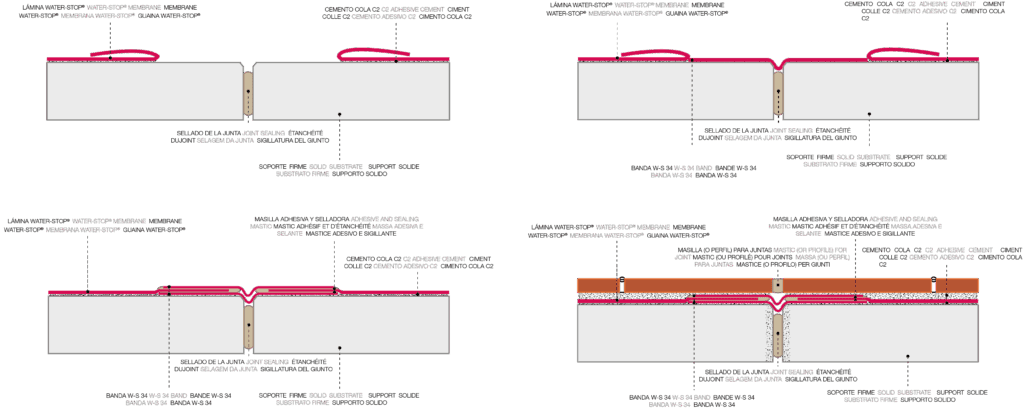
- Water-Stop elastic waterproofing sheet: Polyolefin membrane (PUR/EVAC) reinforced with geotextile and complemented with W-S Band. This solution presents total adherence to the base mortar and is capable of withstanding dilatations of ±20 %. It is also resistant to small structural movements and pedestrian traffic, and guarantees watertightness even under demanding conditions.
|
Icon |
Advantage |
Description |
|
🔒 |
Continuous sealing |
Uninterrupted barrier under the coating, with no weak points where water can seep through. |
|
↔️ |
High elasticity |
Absorbs expansion and contraction movements of up to ±20% without cracking. |
|
☀️ |
UV and chemical resistance |
It maintains its properties being resistant to solar radiation, hydrocarbons and many industrial products. |
|
🧱 |
Compatibility with mortars |
It adheres perfectly to mortars and C2/C2FT adhesives without the need for special primers. |
|
🚶 |
Light pedestrian traffic |
Suitable for indoor and outdoor areas, supporting pedestrian and light vehicular traffic. |
|
🛠️ |
Simple installation |
Flexible sheet applied with adhesive mortar and overlapping strips; no complex construction work required. |
|
∞ |
Unlimited service life (subject to structure) |
As long as the structure withstands the movements, the membrane does not require periodic replacement. |
How to waterproof an expansion joint with Water-Stop?
To properly apply Water-Stop, follow the “Water-Stop Installation Guide for Roofs”:
- Prepare the substrate: joint ≥ 30 mm wide, edges beveled at 45 °; clean and dry the surface.
- Apply adhesive mortar: 4×4×4 mm notched trowel; C2 mortar, 2-2.5 kg/m².
- Lay the membrane: Leave 150 mm of overlap, press with a smooth trowel.
- Joint reinforcement: Stop the sheet 20-30 cm before, place W-S Band centered (20 mm bellows) and seal up to 20 cm in height.
- Sealing overlaps: Overlap 100 mm, seal joints with W-S Mastic or W-S Butyl.
- Finishing: Light traffic in 24 h; normal in 48 h (< 10 m²). Fill with grout or sanitary silicone.
Frequently asked questions about installation joints
How often should I place a floor expansion joint?
In concrete, every 5-8 m; in ceramic, every 4-6 m.
What is the difference between a control joint and an expansion joint?
The control joint manages small cracks; the expansion joint absorbs larger movements.
How to size a concrete expansion joint?
ΔL = α-L-ΔT, plus 10 % safety.
What separation should be left between buildings?
10-20 cm, with watertight profiles and gutters.
Is Water-Stop suitable for waterproofing expansion joints in facades and roofs?
Yes, it is approved for flat roofs, flat roofs and rooftop and rooftop junctions, with unlimited service life (subject to the structure).